

Exploring Strategic Decision Intelligence Use Cases and Applications
In today’s complex business landscape, understanding decision intelligence use cases is critical for organizations striving to maintain a competitive edge. Building on this, the integration of data science, managerial frameworks, and artificial intelligence allows companies to optimize their strategic pathways. By leveraging advanced data-driven decision making and AI project management, modern enterprises can translate raw data into precise, actionable outcomes.
What Does Decision Intelligence Mean in Modern Business?
Decision intelligence use cases represent the practical application of data science, social science, and managerial frameworks to solve specific business problems. Rather than simply generating dashboards, these applications focus on how automated and augmented insights directly inform operational, tactical, and strategic choices within an enterprise. In practice, this discipline connects the dots between organizational data sets and the outcomes of specific choices, creating a repeatable framework for business optimization.
How Decision Intelligence Creates Measurable Business ROI
The strategic value of deploying robust decision intelligence applications lies in the ability to reduce uncertainty and accelerate enterprise time-to-value. Organizations that rely on this discipline transition from reactive troubleshooting to proactive strategy formulation, dramatically improving their market responsiveness. This shift reduces the friction associated with complex problem-solving and aligns tactical operations with overarching corporate objectives, directly impacting the bottom line.
“Organizations utilizing decision intelligence frameworks reduce decision-making time by up to 30%, significantly accelerating speed to market.”
What Are the Key Pillars of a Decision Intelligence Framework?
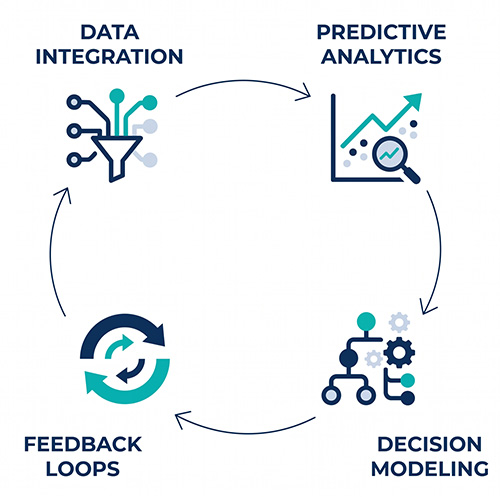
A successful framework relies on several foundational pillars designed to support AI project management and data-driven operations:
- Data Integration: Unifying disparate data streams into a cohesive, single source of truth to inform the analytical models.
- Predictive Analytics: Utilizing historical data and machine learning algorithms to forecast future trends and business behaviors.
- Decision Modeling: Mapping out the relationships between variables, actions, and desired business outcomes to visualize potential impacts.
- Continuous Feedback Loops: Implementing mechanisms that monitor the results of decisions and feed that data back into the system for ongoing optimization.
Where Is Decision Intelligence Used Across Industries?
Across various sectors, organizations are implementing these frameworks to solve highly specific, complex challenges. Supply chain optimization is one prominent example, where companies use predictive models to anticipate disruptions, manage inventory levels dynamically, and route logistics efficiently. Another critical area is dynamic pricing in retail and finance, where algorithms analyze market demand, competitor pricing, and consumer behavior in real-time to adjust prices, thereby maximizing both volume and margin.
“By 2025, over 33% of large organizations will have analysts practicing decision intelligence, marking a significant shift in corporate operations.”
How to Successfully Deploy Decision Intelligence Across Teams
Transitioning to a highly optimized, decision-centric model requires deliberate planning and structured execution. First, organizations must establish clear objectives by identifying the specific business problems that need solving. Following this, ensuring data quality and accessibility is paramount, as the analytical outputs are only as reliable as the inputs. Furthermore, fostering a culture that embraces data-driven insights and integrates them seamlessly with core business processes ensures that technology serves human strategists rather than working in silos.
To compare commercial software providers, integration frameworks, and enterprise-grade modeling suites, browse the DecideWise Decision Intelligence Vendor Directory.
Essential Takeaways on Decision Intelligence Adoption
- Decision intelligence transforms raw data into a structured, actionable framework for strategic enterprise choices.
- Implementing these models significantly reduces operational uncertainty and accelerates enterprise time-to-value.
- Core components include data integration, predictive analytics, decision modeling, and continuous feedback loops.
- Prominent applications span across supply chain optimization, dynamic pricing, and comprehensive risk management.
- Successful implementation demands a strict focus on high-quality data and clear, objective-driven project planning.
Visit the DecideWise Community for deeper insight on this decision intelligence article and community-led topic.