
Operationalizing AI Algorithms: Bridging the Gap Between Models and Decision Intelligence
The true value of artificial intelligence lies not in generating isolated model predictions, but in operationalizing AI algorithms within daily business processes. While foundation models and generative AI captivate enterprise leaders, sustainable competitive advantage depends on seamless decision orchestration across technical and operational teams. By treating model deployment as an ongoing operational discipline, organizations can turn algorithmic output into repeatable enterprise value.
What Does Operationalizing AI Algorithms Actually Mean?
Operationalizing AI algorithms is the systematic practice of embedding machine learning models, and analytical outputs directly into business or decision rules as automated or human-guided decision workflows. Rather than treating an algorithm as a static artifact or isolated research project, this discipline focuses on continuous execution, model monitoring, dynamic feedback loops, and integration with existing enterprise software. Within modern decision intelligence frameworks, operationalization bridges the gap between raw analytical predictions and measurable operational outcomes.
Operationalizing AI Algorithms Matters for Enterprise Growth
Organizations often invest heavily in model design, only to face deployment bottlenecks and minimal business ROI. Building on this operational bottleneck, operationalizing AI algorithms enables enterprises to standardize decision-making processes across departments, reduce decision latency, and enforce continuous compliance. Effective operationalization aligns software delivery, data pipelines, and strategic governance so that algorithmic recommendations directly inform front-line operations.
Furthermore, integrating operational workflows with structured AI project management ensures that machine learning models remain aligned with evolving business Key Performance Indicators (KPIs). In practice, this strategic alignment shifts the focus from experimental model accuracy to scalable enterprise AI adoption and reliable business execution.
“Decision intelligence integrates data, analytics, machine learning, and decision orchestration to make every enterprise action consistent, explainable, and actionable.”
— Gartner Research, gartner.com
Building Blocks for Decision Orchestration and MLOps Workflows
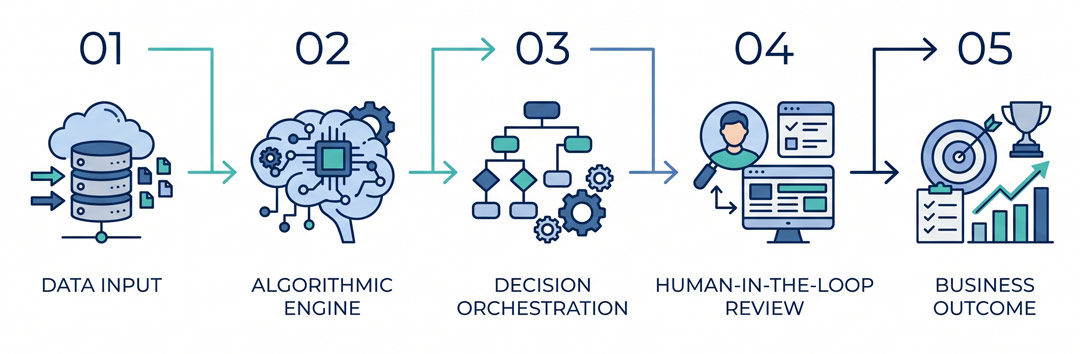
Successfully embedding analytical models into production environments requires a holistic architecture combining technology, governance, and cross-functional process management. Core components include:
- Decision Orchestration: Linking machine learning outputs with business rules engines and automated workflow platforms.
- Human-in-the-Loop Governance: Establishing clear intervention protocols where human subject matter experts review high-stakes algorithmic outputs.
- Model Performance & Drift Monitoring: Tracking model accuracy, concept drift, and data quality metrics in real-time production environments.
- Robust MLOps Pipelines: Automating data ingestion, continuous integration, continuous deployment (CI/CD), and model retraining.
- Cross-Functional Alignment: Synchronizing data science teams, software developers, and business stakeholders under structured operational frameworks.
Looking to identify the right vendors and tools to build this architecture? Explore our comprehensive DecideWise 2026 Tech Landscape to see how the market is evolving.
How Industry Leaders Deploy Algorithmic Workflows in Production
In financial services, operationalizing algorithms allows automated credit underwriting systems to evaluate risk in real time while routing edge cases to senior loan officers for manual review. Building on this hybrid model, healthcare institutions deploy diagnostic algorithms directly into electronic health record workflows, alerting clinicians to critical patient risk factors without disrupting standard care routines.
Similarly, supply chain organizations utilize decision intelligence systems to automatically re-route inventory based on predictive demand models and dynamic logistics constraints. By embedding algorithms into operational software, these organizations achieve immediate, scalable action rather than static dashboard reporting.
“Over 80% of enterprise AI projects fail to reach production not due to algorithmic flaws, but because of gaps in deployment infrastructure and organizational workflow integration.”
— VentureBeat Research, venturebeat.com
Best Practices for Moving AI Models from Sandbox to Production
To successfully transition models from sandbox environments to core operations, organizational leaders must adopt practical implementation strategies:
- Define Decision Architecture First: Map the specific business decision, input data, rules, and desired business outcome before selecting or training algorithms.
- Apply Agile AI Project Management: Utilize iterative delivery sprints that unite data engineers, business domain experts, and IT personnel around shared operational goals.
- Establish Standardized APIs and Services: Package algorithms as modular microservices to enable seamless integration across legacy enterprise systems.
- Implement Comprehensive Audit Trails: Record all model inputs, parameter states, and output decisions to satisfy regulatory compliance and internal governance.
Summary: Essential Takeaways for AI and Business Leaders
- Algorithmic sophistication provides minimal ROI without structured operational workflows and decision orchestration.
- Operationalizing AI algorithms requires combining machine learning outputs with business rules, human expertise, and real-time monitoring.
- Cross-functional alignment across data science, IT, and business leadership is vital for sustainable enterprise AI adoption.
Visit the DecideWise Community for deeper insight on this decision intelligence article and community-led topic.