

Integrating Third-Party Resources for Robust Decision Intelligence Architectures
Modern enterprise environments are rapidly shifting towards modular decision-making structures that require the seamless integration of specialized external decision support integrations and third-party decision intelligence resources. By coupling in-house data platforms with specialized tools, organizations can accelerate their digital transformation and achieve faster time-to-value. Furthermore, this modular approach supports advanced AI project management by allowing teams to leverage tested, external components rather than building from scratch.
What Are Third-Party Decision Intelligence Tools?
Third-party decision intelligence tooling encompasses commercial off-the-shelf software (COTS), specialized APIs, and open-source modules designed to automate, optimize, and support enterprise choices. Instead of building custom infrastructure from scratch, enterprise architects evaluate commercial decision intelligence vendors and products to embed specialized rules engines, optimization solvers, and predictive models directly into operational workflows. Ultimately, these tools shift how organizations process data—moving from passive collection to active, automated decision-making.
Architecture Flow: Third-Party Decision Intelligence Integrations
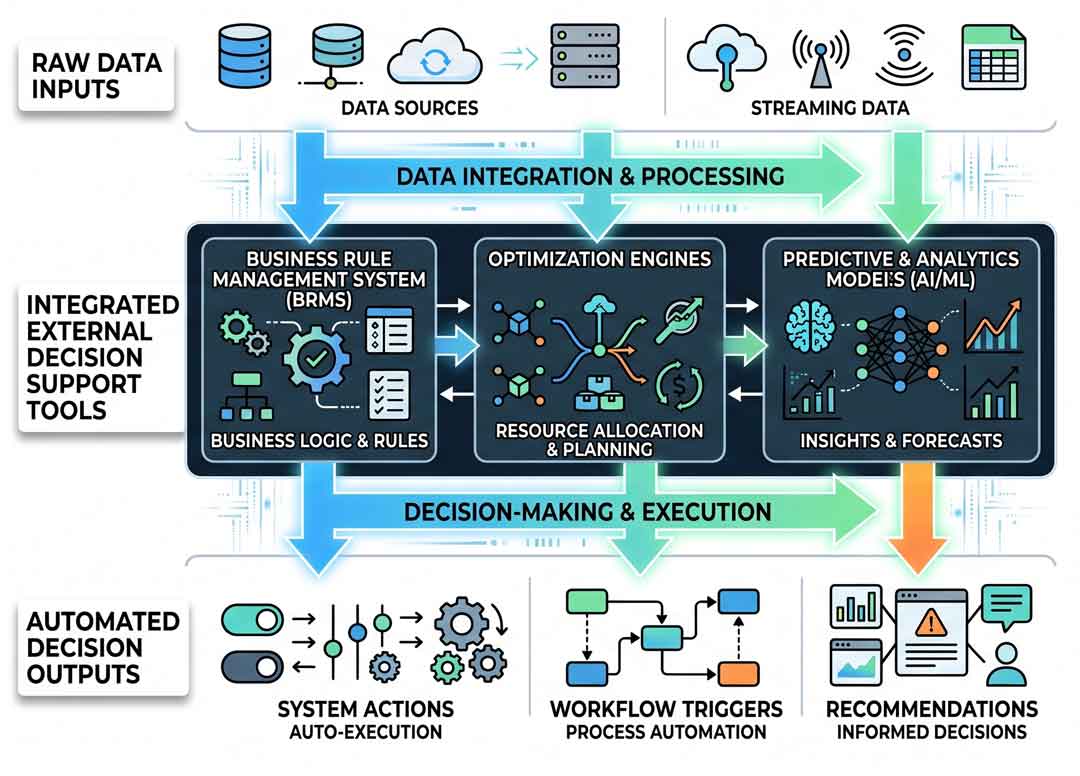
This infographic illustrates the end-to-end data pipeline of integrated decision systems. It traces raw enterprise data from ingestion, through external decision logic layers—including predictive analytics, business rules management systems (BRMS), and optimization solvers—to final automated operational outputs and continuous audit logging.
Why Enterprises Build with External Decision Intelligence Tools
Relying solely on internal development of decision models and automation engines is resource-intensive and often delays deployment. Building on this, the primary value of integrating third-party resources is speed. Enterprises reduce development cycles by leveraging mature, specialized solutions for niche functions, such as optimization algorithms or real-time predictive analytics. This modular strategy allows organizations to focus core engineering efforts on unique, proprietary business logic while offloading standard or highly specialized components.
“By 2027, 50% of business decisions will be augmented or automated by AI agents for decision intelligence.” — Gartner (Source)
Essential Modules in Third-Party Decision Intelligence Tooling
Effective third-party resources provide the critical components needed to bridge the gap between data and action:
- Decision Modeler & Simulation Environments: Visual tools that allow business analysts to model complex decision logic using standards like DMN before deployment.
- Predictive Analytics and Machine Learning Engines: External APIs and platforms providing advanced demand forecasting, propensity modeling, and risk scoring.
- Business Rules Management Systems (BRMS): Robust engines that manage and execute declarative business rules, enabling quick policy updates without code changes.
- Optimization Solvers: Specialized algorithmic engines for complex resource allocation, scheduling, and logistics optimization.
- Data Governance and Decision Provenance Tools: Platforms that track decision lineage, audit data inputs, and ensure model compliance.
- Integrated AI Project Management Suites: Tools that link business objectives with the entire lifecycle of an AI model, from data preparation to deployment and monitoring.
How Companies Use Third-Party Decision Tools in Production
In practice, third-party decision intelligence resources are critical for executing complex operational decisions at scale:
Financial Risk and Fraud Management
In the financial sector, banks and fintechs integrate third-party risk intelligence databases and real-time behavioral analytics APIs into their core transaction systems. This automated flow allows for instantaneous fraud checks during transaction processing, immediately flagging or blocking suspicious activity based on global intelligence rather than relying solely on internal data.
Supply Chain Optimization
Logistics and retail companies integrate external weather forecasting, global shipping data, and inventory optimization solvers into their decision pipelines. When a storm or port disruption occurs, the integrated third-party systems automatically recalculate optimal distribution routes and adjust inventory reorder points across the network, ensuring minimal operational impact.
“Decision Intelligence empowers organizations to act with greater confidence and control—transforming decision-making from a bottleneck into a source of speed, scale, and advantage.” — InRule (Source)
Best Practices for Deploying External Logic and Decision Governance
Successfully integrating external decision support integrations requires strong governance and technical rigor:
- Define Decision Boundaries and Ownership: Clearly specify which decision points are managed by third-party tools and which are handled by internal systems, assigning clear business ownership for each logic segment.
- Ensure Interoperability and API Standardization: Prioritize tools that adhere to open standards and offer well-documented APIs to facilitate easy swapping or integration with existing data stacks.
- Maintain Comprehensive Governance: Establish clear guidelines on data usage, security, and model explainability, ensuring third-party providers meet enterprise compliance standards.
- Validate and Monitor Decision Quality: Continuously monitor the performance and accuracy of automated decisions, implementing human-in-the-loop validation for high-stakes scenarios.
Key Takeaways for Enterprise Architecture Leaders
- Third-party decision intelligence resources provide essential, pre-built components that accelerate enterprise automation and reduce engineering overhead.
- Strategic use of these external resources significantly improves time-to-value for complex DI projects.
- Success depends on well-defined decision governance, seamless API interoperability, and rigorous monitoring of automated decision quality.
- Balancing in-house expertise with specialized external integrations creates a resilient and high-performance decision-making ecosystem.
Visit the DecideWise Community for deeper insight on this decision intelligence article and community-led topic.