

Top Decision Intelligence Companies and Vendors Shaping the Market
The landscape of decision intelligence companies is rapidly evolving as organizations seek to automate and augment complex choices. Identifying the right decision intelligence vendors has become a critical priority for technology leaders. This ecosystem now extends far beyond traditional business intelligence, integrating advanced analytics and AI project management to deliver actionable, data-driven outcomes.
What Decision Intelligence Vendors Do Differently
Decision intelligence is a practical discipline that brings together traditional and advanced techniques to design, model, align, execute, and monitor decision models and processes. Top decision intelligence companies provide the software and frameworks necessary to transition from retroactive reporting to proactive, automated actions. Unlike legacy business intelligence platforms that merely display historical data, this technology evaluates present conditions to formulate the best possible course of action.
“Gartner defines decision intelligence platforms as software that creates decision-centric solutions to support, augment and automate decision making via data, analytics, knowledge and AI composition.”
— Gartner, Best Decision Intelligence Platforms Reviews 2026
The Strategic Value of Decision Intelligence Companies
Building on this, the strategic value of deploying solutions from leading decision intelligence vendors lies in the ability to process vast amounts of unstructured data and convert it into immediate competitive advantages. Organizations can reduce the latency between insight and execution, transforming operational bottlenecks into streamlined workflows. This capability is especially critical for optimizing resource allocation, improving forecasting accuracy, and enhancing AI project management outcomes at an enterprise scale.
“The global decision intelligence market size was valued at USD 16.79 billion in 2024. The market is projected to grow from USD 19.38 billion in 2025 to USD 57.75 billion by 2032, exhibiting a CAGR of 16.9%…”
— Fortune Business Insights, Decision Intelligence Market Size, Share & Global Report [2032]
Core Capabilities of Advanced Decision Platforms
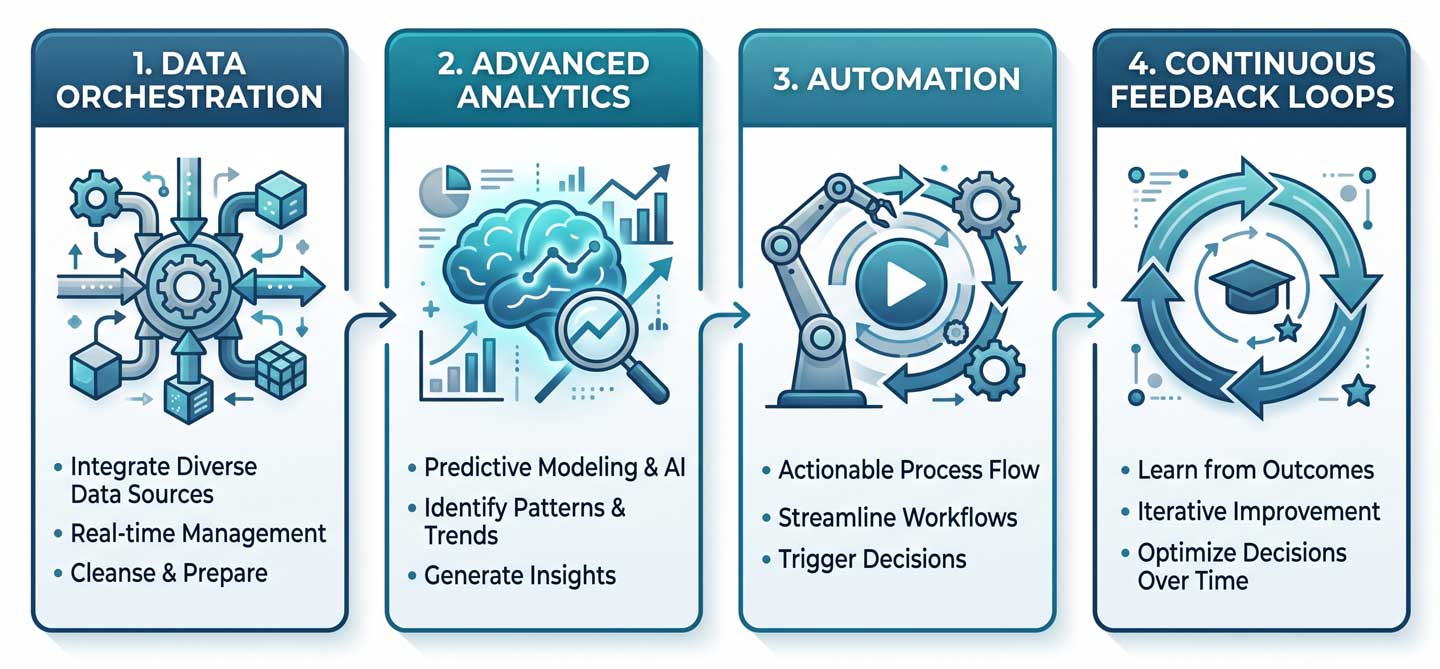
To effectively evaluate decision intelligence vendors, organizations must look for several foundational capabilities within their platforms:
- Data Orchestration: The ability to seamlessly ingest, clean, and unify data from siloed enterprise systems.
- Advanced Analytics: The inclusion of machine learning and predictive modeling to forecast potential outcomes.
- Execution and Automation: Features that allow the platform to autonomously trigger operational workflows.
- Continuous Feedback Loops: Mechanisms that monitor decision outcomes and refine underlying algorithms over time.
Real-World Applications
In practice, decision intelligence companies are driving measurable transformations across multiple industries. Retail enterprises leverage these platforms to automate dynamic pricing and inventory replenishment based on real-time market signals. In the financial sector, banks deploy these frameworks to accelerate risk assessment and fraud detection, evaluating thousands of variables in milliseconds. Supply chain leaders utilize the technology to predict disruptions and automatically reroute shipments, ensuring operational continuity despite external volatility.
Implementation Best Practices
Selecting and deploying software from decision intelligence vendors requires a structured approach to ensure maximum return on investment. Organizations should start by mapping precise decision contexts before evaluating specific platform features. It is essential to bridge the gap between business intelligence teams and operational leaders to ensure alignment on strategic objectives. Furthermore, prioritizing robust change management alongside AI project management initiatives will drive faster adoption and mitigate organizational resistance. Finally, launching with a high-impact, narrowly defined pilot project often yields the best initial results.
Key Takeaways
- The market of decision intelligence companies is expanding rapidly to meet escalating enterprise demand for automated insights.
- Modern decision intelligence vendors offer predictive capabilities that far surpass traditional business intelligence.
- Successful software deployment relies on clear decision mapping and rigorous AI project management frameworks.
- Organizations that adopt these technologies effectively achieve significant competitive advantages through accelerated, highly accurate decision-making.
Visit the DecideWise Community for deeper insight on this decision intelligence article and community-led topic.