

Understanding Decision Intelligence: Core Elements and Strategic Value
In a rapidly evolving digital landscape, Decision Intelligence has emerged as a crucial discipline for translating complex data into actionable outcomes. By merging data science with social science and managerial theory, organizations can fundamentally enhance their business decision making capabilities. This multidisciplinary approach goes beyond basic analytics, offering a structured foundation for effective AI project management and comprehensive data-driven strategy.
What is Decision Intelligence?
Decision Intelligence is a practical domain that frames a wide range of decision-making techniques, integrating machine learning, complex systems modeling, and human judgment. It is designed to overcome the limitations of traditional artificial intelligence by focusing on the actual decision rather than just the predictive model. By creating a clear mapping of how actions lead to outcomes, this framework empowers organizations to make faster, more reliable, and highly scalable choices.
“Decision intelligence provides a framework to bring multiple traditional and advanced disciplines together to design, model, align, execute, monitor and tune decision models and processes.”
Source: Gartner IT Glossary
The Strategic Value of Decision Intelligence
Building on this foundational understanding, the true strategic value of this discipline lies in its ability to mitigate human cognitive biases and reduce organizational blind spots. By continuously feeding real-time data into decision models, businesses can pivot swiftly in volatile markets. This adaptive capability reduces operational risks and maximizes ROI, proving essential for leaders attempting to navigate complex macroeconomic variables.
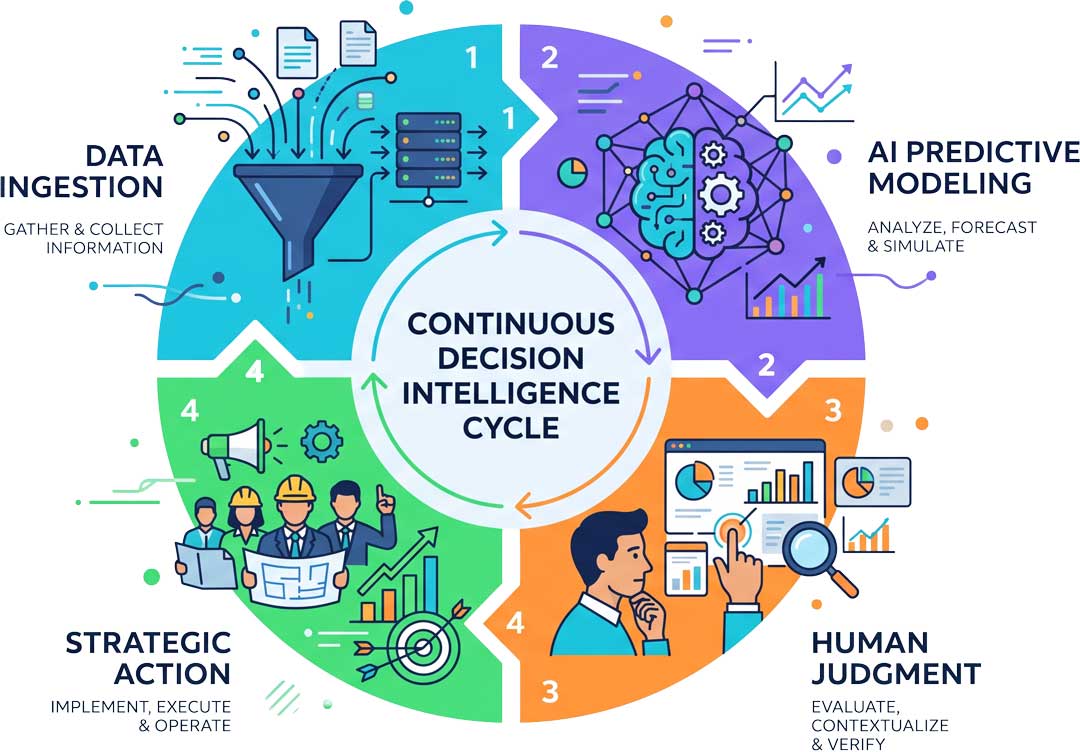
Core Elements of Decision Intelligence
A robust capability requires several interconnected components working in harmony:
- Data Infrastructure: A seamless pipeline of clean, structured, and unstructured data serving as the foundation for all analytics.
- Predictive Analytics & AI Models: Algorithms that forecast potential outcomes based on historical trends and emerging patterns.
- Decision Modeling: Visual and mathematical representations of how decisions are made, linking inputs directly to business metrics.
- Human-in-the-Loop Integration: Mechanisms that ensure human expertise, ethics, and contextual understanding remain central to the final decision.
Real-World Applications
In practice, modern enterprises deploy these systems across various departments to drive tangible results. For example, supply chain operators use sophisticated models to predict inventory shortages and automatically reroute shipments before bottlenecks occur. Similarly, financial institutions leverage it for advanced fraud detection, rapidly analyzing millions of transactions while minimizing false positives that frustrate legitimate customers.
Implementation Best Practices
Successfully adopting this framework requires a deliberate, phased approach. Organizations should start by identifying a single, high-impact business problem rather than attempting a massive organizational overhaul. Establish a cross-functional team that bridges the gap between technical data scientists and frontline business stakeholders. Furthermore, investing in rigorous AI project management ensures that models are continuously monitored and recalibrated as market conditions shift.
“By 2023, more than a third of large organizations will have analysts practicing decision intelligence, including decision modeling.”
Key Takeaways
- Decision Intelligence connects data science with human judgment to improve organizational outcomes.
- It offers immense strategic value by reducing cognitive bias and accelerating response times.
- Successful implementation relies on strong data infrastructure, clear decision modeling, and robust AI project management.
- Starting with focused, high-impact use cases is the most effective path to widespread organizational adoption.
Visit the DecideWise Community for deeper insight and discussion on this decision intelligence article and community-led topic.