

Strategic Role of AI in Decision Intelligence Ecosystems
The intersection of an artificial intelligence strategy and human expertise is rapidly transforming how organizations approach complex business challenges. While foundational machine learning models provide vast analytical power, the integration of AI in decision intelligence frameworks bridges the critical gap between raw data and executable enterprise actions. Furthermore, incorporating related disciplines like AI project management ensures these advanced systems are deployed with measurable impact, accountability, and strong governance.
What is AI-Driven Decision Intelligence?
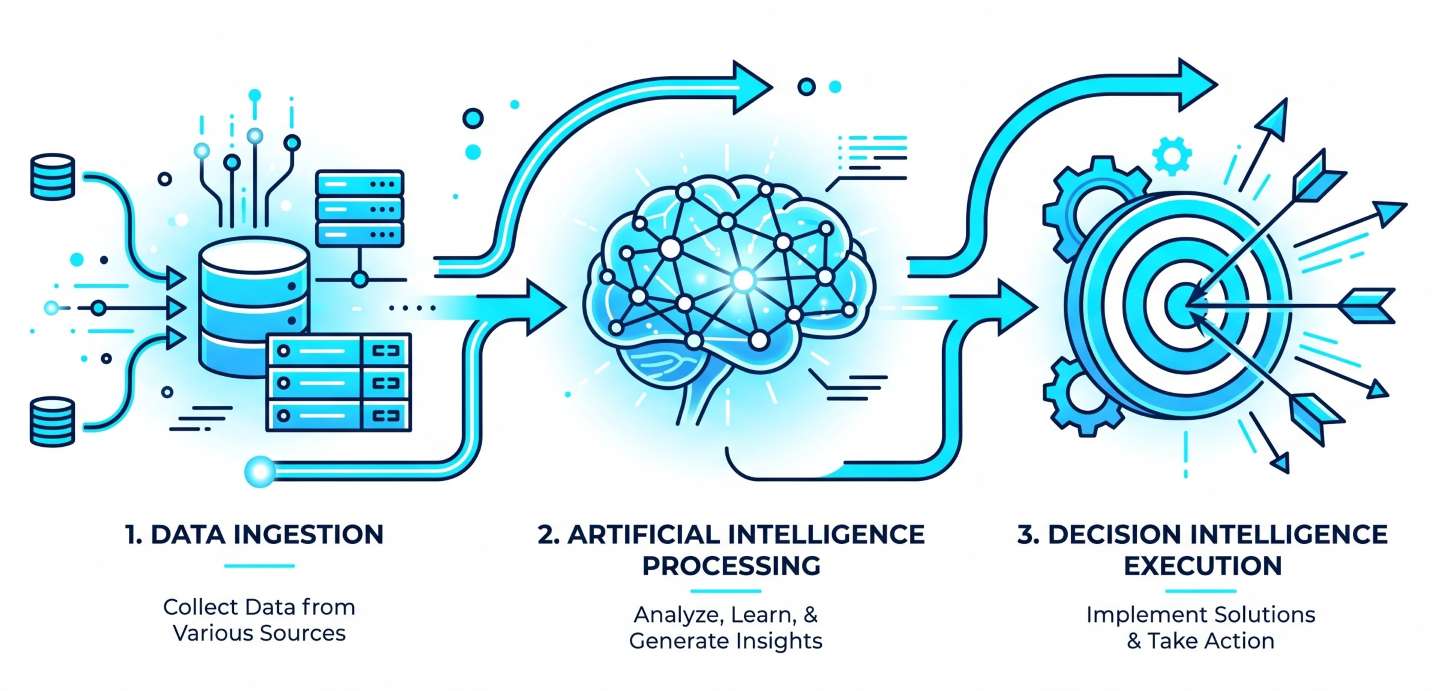
AI-driven decision intelligence represents the natural evolution of traditional analytics, purposefully combining data, managerial, operational, and behavioral sciences into a cohesive discipline. It shifts the operational focus from simply analyzing historical data to proactively prescribing actionable, future-looking choices. Building on this, the primary distinction lies in context; while artificial intelligence efficiently processes massive datasets to identify hidden patterns, decision intelligence provides the overarching framework required to apply those technological insights in alignment with overarching strategic business goals.
The Strategic Value of AI in Decision Intelligence
Implementing a robust artificial intelligence strategy within enterprise decision frameworks drastically reduces cognitive bias and accelerates organizational response times. Modern enterprises face an overwhelming volume of variables, making manual evaluation of every possible outcome nearly impossible. By automating the underlying analytical heavy lifting, AI enables leadership to focus strictly on strategic alignment and complex problem solving.
“By 2023, more than 33% of large organizations will have analysts practicing decision intelligence, including decision modeling.” – Gartner Gartner D&A Trends
In practice, integrating these technologies means leadership can confidently transition from reactive troubleshooting to proactive optimization. This operational shift inherently supports superior AI project management, as cross-functional teams can accurately allocate resources based on predictive outcomes rather than relying on lagging historical indicators.
Core Elements of AI-Enhanced Decision Making
- Data Orchestration: Centralizing and cleaning disparate data sources to feed accurate, unbiased inputs into algorithmic models.
- Predictive and Prescriptive Analytics: Utilizing advanced machine learning algorithms to forecast complex scenarios and recommend the optimal path forward.
- Contextual Framing: Ensuring AI outputs are strictly evaluated against practical business constraints, compliance requirements, and market realities.
- Continuous Feedback Loops: Actively monitoring the real-world results of executed decisions to continually refine and improve the underlying artificial intelligence strategy over time.
Real-World Applications
Organizations across multiple sectors are seeing tangible, quantifiable benefits from merging these advanced disciplines. In supply chain logistics, for example, AI models can instantly predict potential global disruptions due to weather or geopolitical events, while the decision intelligence framework automatically triggers supplier pivots based on predefined corporate risk tolerances. Similarly, within financial services, fraud detection algorithms alert analysts to anomalies, but sophisticated decision logic determines whether to instantly freeze an account or simply flag it for secondary review based on the customer’s lifetime value.
“Companies that successfully scale artificial intelligence in their core decision-making processes are seeing a 20% or higher impact on their bottom-line earnings.” – McKinsey & Company State of AI in 2023
Implementation Best Practices
Deploying AI in decision intelligence requires a highly structured, deliberate approach to avoid common enterprise pitfalls. Start by explicitly mapping out the most critical decision-making workflows within the organization prior to applying any technical solutions. In practice, aligning these initial deployments with stringent AI project management methodologies ensures that critical timelines, technical budgets, and ethical considerations are meticulously tracked. Above all, focus on algorithmic transparency; stakeholders must clearly understand how a model reached its conclusion in order to fully trust and execute the prescribed action.
Key Takeaways
- Decision intelligence acts as the essential strategic wrapper around underlying artificial intelligence capabilities.
- Successful enterprise implementation requires flawlessly aligning algorithmic outputs with core business objectives.
- Effective AI project management is absolutely crucial for deploying these complex frameworks securely, ethically, and transparently.
- Organizations must prioritize and build continuous feedback loops to incrementally improve decision accuracy and model reliability.
Visit the DecideWise Community for deeper insight on this decision intelligence article and community-led topic.