

The Strategic Role of Business Rules in Decision Intelligence
As organizations scale their data capabilities, foundational tools like business rules remain essential for operationalizing analytics, AI, and bridging the gap between raw data and executable actions. In the broader context of AI project management, integrating these rules ensures that automated decisions are transparent, governed, and aligned with organizational policies. Building on this, establishing a robust framework for decision intelligence requires both advanced predictive models and the dependable logic of expert systems.
“By 2027, 50% of business decisions will be augmented or automated by AI agents for decision intelligence. As more decisions move to machines, the logic behind each one matters as much as the outcome.”
— Gartner (2025) View Source
What Role Do Business Rules Play in Decision Intelligence?
Business rules are foundational logic frameworks, historically rooted in expert systems, that document and refine how an organization operates. Rather than relying on traditional software programming languages, these systems use plain-language logic to provide accessible, executable guidelines. By capturing institutional knowledge, they act as an enterprise-wide system of record for operationalizing analytics, translating complex business strategies into immediate, automated actions.
Why Business Rules Still Matter in an AI-Driven Enterprise
The enduring prominence of business rules stems from their distinct advantages over conventional programming environments. These systems democratize logic authoring, allowing business leaders and subject matter experts to document processes without needing deep technical coding skills. In practice, this delivers enhanced explainability and auditability, ensuring that stakeholders understand exactly why a specific decision was made. Furthermore, decision rules provide greater flexibility for debugging, testing, and rapid change management, making them an agile component within modern decision intelligence architectures.
The Four Core Building Blocks of Business Rules
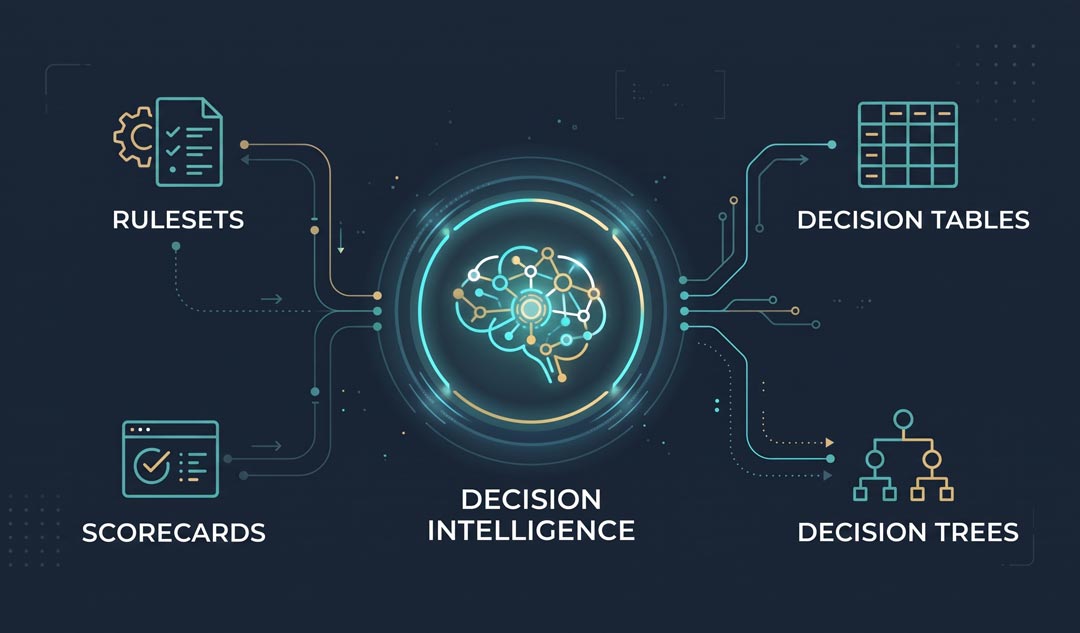
At the core of these platforms are specialized tools that help organize and automate complex conditions:
- Rulesets: Collections of fundamental if-then statements (e.g., “If credit score is below 600, decline the loan”) that organize baseline logic.
- Decision Tables: Grid-based formats that list multiple conditions and outcomes, functioning as dynamic matrices to map combinations of scenarios simultaneously.
- Decision Trees: Visual flowcharts that branch out based on sequential yes/no or threshold answers, guiding processes step-by-step to a final conclusion.
- Scorecards: Predictive analytics tools that assign weighted points to different risk factors (such as age, income, or existing balances) to output a cumulative score measuring the future likelihood of an action.
Operationalizing Decisions: How Business Rules Work in Practice
While frequently associated with financial services for credit scoring and loan approvals, business rules operationalize processes across every industry. For instance, a university admissions department might process tens of thousands of applications using a robust rules engine. By routing data—such as standardized test scores, essay evaluations, and financial need metrics—through an established set of rules, the institution can sift through candidates in fractions of a second. Even if the underlying predictive data changes, the foundational decision flow remains consistent, making it a reliable driver for enterprise data science.
Best Practices for Scaling Rules Within Your Decision Architecture
When integrating business rules into a broader AI project management strategy, organizations must navigate a crowded market of over forty vendors. To ensure a scalable decision intelligence system, it is crucial to match the specific rules solution to the exact enterprise use case. Decision rules engines excel at simulation, pre-determined optimization, and data parsing, but they should not be conflated with dedicated digital twin technologies or pure Python programming environments. Best practice dictates using rules to orchestrate logic, while cleanly integrating external AI and predictive analytics tools where deep machine learning is required.
“Organizations that prioritize semantics and logic in AI-ready data will increase their generative AI model accuracy by up to 80% and reduce costs by up to 60%, facilitating smarter, faster decision-making.”
— Gartner (2025) View Source
Key Takeaways for Decision Intelligence Teams
- Democratized Knowledge: Business rules empower non-technical experts to capture, manage, and automate critical business logic.
- Operational Agility: They enable organizations to adapt quickly to market changes by adjusting logic tables instead of rewriting core software code.
- Clear Explainability: Unlike black-box AI models, rulesets provide total transparency for compliance, auditing, and governance.
- Architectural Centrality: Rules engines remain the definitive connective tissue between predictive analytics and automated business outcomes in any decision intelligence system.
Visit the DecideWise Community for deeper insight on this decision intelligence article and community-led topic.