

Operationalizing AI: Why and How Enterprises Turn Compute into Measurable ROI
The era of speculative artificial intelligence infrastructure funding is closing, making way for a necessary focus on measurable business outcomes. As hyperscalers and hardware vendors adjust to market realities, organizations must pivot toward operationalizing their investments through decision intelligence. Effective AI project management and structured decision architectures are now critical for generating real return on investment.
What Does Operationalizing AI Mean for Enterprises?
Operationalizing AI is the discipline of embedding artificial intelligence models, data analytics, and business logic directly into core enterprise workflows to automate and improve day-to-day decisions. Rather than treating generative models or raw compute capacity as standalone novelties, this approach connects technical outputs to specific operational actions and financial key performance indicators. In practice, it bridges the gap between experimental data science and production-grade decision intelligence systems that deliver auditable, repeatable return on investment.
Why Enterprises Must Shift from Raw Compute to Measurable ROI
The strategic value of operational AI stems from an urgent economic reality: massive capital expenditures in data centers and silicon can no longer be justified by speculative model training alone. Following leadership shakeups and tightening capital discipline across the hardware and cloud ecosystem, the industry faces a steep revenue mandate. To sustain infrastructure build-outs without triggering severe GPU oversupply and margin compression, enterprise buyers must extract tangible financial value from their software stacks.
Building on this market inflection point, raw compute and foundational models do not generate profit on their own. Organizations only capture return on investment when intelligence is systematically applied to solve expensive, high-friction operational bottlenecks. Transitioning from infrastructure accumulation to decision intelligence protects enterprises from stranded technology investments, aligns technical spend with bottom-line performance, and shifts focus from vendor hype to accountable business execution.
“The neoclouds should be very nervous about losing their patron, along with their creditors and equity holders. The other problem is that the revenue necessary to make all of this build-out work is something on the order of a trillion dollars industry-wide, and it needs to materialize sooner rather than later.” – Ben Thompson, Stratechery
Five Pillars of a Production-Ready Decision Architecture
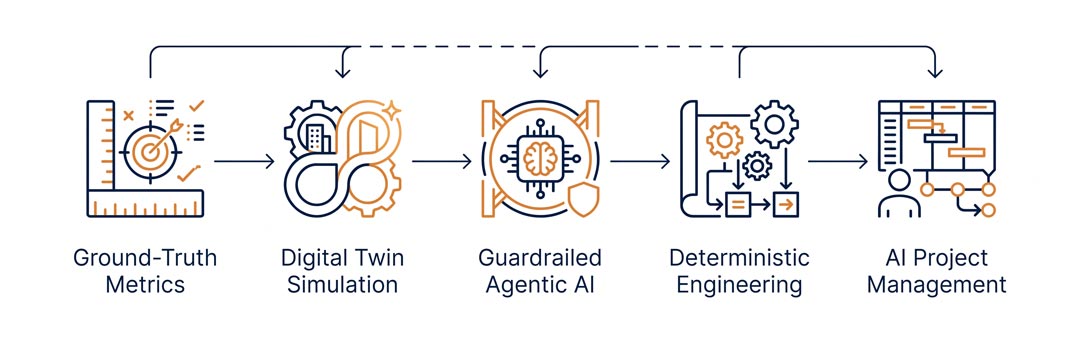
Moving from isolated AI pilots to production-ready decision systems requires executing across a structured lifecycle. In practice, enterprises translate compute investments into business outcomes by combining five core technical and managerial elements:
- Ground-Truth Metrics Development: Establishing rigorous descriptive analytics and baseline key performance indicators before deploying automation, ensuring every model optimizes toward a verified business outcome.
- Simulation and Digital Twin Modeling: Testing proposed operational changes inside risk-free virtual environments to validate financial and logistical impacts prior to committing physical capacity or capital.
- Guardrailed Agentic AI Integration: Designing autonomous workflows that execute multi-step business logic within strict policy boundaries, preventing model hallucinations from eroding operating margins.
- Deterministic Engineering Discipline: Evaluating when traditional rules engines, operations research, or deterministic software deliver faster, cheaper, and more reliable results than generative models.
- AI Project Management: Governing cross-functional delivery across data science, software engineering, and operations so initiatives remain tied to production budgets and measurable milestones.
Operationalizing AI in Action: Supply Chain and Financial Services
Across capital-intensive industries, organizations are replacing disconnected analytical dashboards with closed-loop decision workflows. In global supply chain operations, practitioners combine real-time telemetry with simulation modeling and predictive algorithms to automate inventory allocation, dynamic routing, and supplier risk mitigation. Rather than waiting for manual spreadsheet reviews, automated workflows evaluate cost-to-serve trade-offs and execute adjustments continuously.
Similarly, financial services institutions apply hybrid decision architectures to underwriting and fraud prevention. Instead of relying solely on opaque generative models, engineering teams pair deterministic compliance rules with machine learning anomaly detection. This approach accelerates credit approvals while maintaining full auditability and risk control.
“77% of U.S. respondents say AI has become increasingly involved in decision-making, while 78% say decision-making has become more complex, highlighting the need for trustworthy data reaching the point of decision.” – Körber AG, Supply & Demand Chain Executive
Best Practices for Scaling AI Project Management and Governance
To capture sustainable value in a post-hype market, technology and business leaders must overhaul how AI initiatives are scoped, architected, and governed. Implementation begins by reversing the traditional technology-first workflow: teams should map high-value operational decisions and quantify target financial outcomes before selecting underlying models or cloud infrastructure.
Building on this decision-first foundation, organizations should enforce vendor-neutral, interoperable decision architectures. Decoupling business logic and orchestration layers from single-vendor foundation models prevents platform lock-in and allows teams to swap components as costs and capabilities evolve. Finally, rigorous AI project management practices—including continuous human-in-the-loop auditing, latency budgeting, and unit-cost tracking per decision—ensure production systems remain profitable at scale.
“74% of CIOs regret at least one major AI vendor or platform selection made in the past 18 months, underscoring the need for a structured decision architecture.” – Dataiku, DecideWise Newsletter
Navigating platform selection and enterprise AI governance requires continuous visibility into a rapidly shifting market. Subscribe to the DecideWise Decision Intelligence Newsletter to stay informed on insights and analysis on decision intelligence, enterprise AI & decision automation, and how companies operationalize data-driven decisions at scale.
Key Takeaways for Operationalizing AI
- The contraction of speculative AI infrastructure funding requires enterprises to prove measurable financial return on existing technology investments.
- Operationalizing AI bridges the gap between raw compute capacity and bottom-line impact by embedding intelligence directly into repeatable business workflows.
- High-performing teams combine ground-truth metrics, digital twin simulations, and deterministic software guardrails rather than relying solely on generative models.
- Vendor-neutral decision architectures protect organizations from platform lock-in and runaway inference costs as the market matures.
- Disciplined AI project management ensures cross-functional alignment between data scientists, software engineers, and operational budget owners.
Visit the DecideWise Community for deeper insight on this decision intelligence article and community-led topic.